Showing posts with label integrated enterprise risk management. Show all posts

Wednesday, January 22, 2014

Aviation Safety Risk Management Database

Risk Management Occurs Within a "System"

Aviation risk management remains the most crucial element of an effective aviation risk management system. Operators manage risk in everyday activities, but we don't focus formal, structured process needed in an ICAO compliant SMS risk management framework.

Managing Aviation Risk Using databases
Aviation providers implementing ICAO compliant SMS programs are recommended to structure risk management strategies according to best practices, which are found in quality aviation risk management database software.


Phases for Managing Aviation-Related Risk

Aviation risk management strategies (or best practices), commonly possess these risk management cycle phases:
Airline and airport risk management best practices
Identify & Report Hazards: Determine whether potential risk exists and report it using formal hazard reporting tools (paper based, Web reporting forms, audits, gap analysis, etc). The SMS Pro™ Web-based hazard reporting form is a customizable solution with automatic email notifications that is recognized as best in class. Other capabilities of SMS Pro's hazard reporting and aviation risk management database software includes:
  • Customized forms requiring minimal costs to incorporate additional data elements;
  • Many predefined Web-based hazard reporting forms for flight operations, maintenance, ect. that meet most user needs;
  • Quick report features for mobile Web users or others who may pressured for time and need to submit a "quick hazard report;"

Assess Risk: Determine severity and probability of risk with a standard, best in class, risk matrix like SMS Pro's Customizable Risk Matrix. Whenever potential risk is minimal (low to medium severity, low likelihood of occurrence), your policies may state that no additional actions is required unless the issue repeatedly occurs. With significant or major risks, which could cause injury or damage to users and equipment, you need to implement reactive risk management processes. Based on reported issue's severity and type of issue, one may also choose to use SMS Pro™ to:
  • Set targeted closure dates (so issues don't remain open forever);
  • Inform regulatory authorities or clients (when required by contract), that the issue has occurred.

Classify Risk: The best risk management database software offers simple, flexible, customizable strategies to classify risk. One must understand risks before they can be managed effectively. Consequently, aviation providers adopt risk classification systems or create their own. Many will start with a template and modify the schema as necessary. Classifying risks (or reported issues) allows aviation organizations to identify and control risk, which is a major element of aviation risk management. SMS Pro™ offers the best system that is very comprehensive, yet flexible enough for all types of organziations, such as airports, airlines, FBOs, MROs, and flight schools. SMS Pros risk classification framework helps identify risk which is useful for generating reports to communicate risk.

Corrective/Preventive Action Plan: Control identified risks based on the risk's severity and likelihood of occurrence. Develop various alternatives and perform a cost/benefit analysis when necessary using SMS Pro™. Automatically generate a Corrective Action Plan for audits, whether they are external or internal audits.

Mitigate or Transfer: Put into action the corrective and preventive actions created in the previous phase to mitigate identified risk. Reassess risk after all corrective and preventive actions have been implemented. When risk is not within acceptable risk management levels, return to the previous phase to put further corrective and preventive actions into play. When corrective and preventive actions fail to reduce risk to acceptable levels, continue analyzing the risk to determine actions to bring the identified risk to an acceptable severity level.

Track: After mitigating risks to an acceptable severity level, track these risks' implemented corrective actions to ensure they remain effective and are controlling the risk. As time passes, ensure implemented corrective actions don't increase risks when they were implemented to alleviate the risk.These items remain the core of any best in breed risk management program. They are easily managed using aviation risk management database software.


About NWDS - founded in 2003 by six software engineers, NorthWest Data Solutions (NWDS) provides custom computer programming and systems design services. NWDS creates many types of software, including e-commerce, financial, defense, engineering, logistics, aviation and more. In 2007, NWDS developed SMS Pro™ a web based SMS application that supports an organization's overall SMS through safety reporting, safety documentation, safety risk management and safety assurance. SMS Pro™ is currently used by aviation organizations in the U.S., Canada, Asia, Latin America, Africa and the Middle East to help manage their SMS programs. NWDS continues to support SMS Pro™ and add new functionality. NWDS offers custom contract programming services in the U.S. and Canada and is managed by Chris Howell, one of the founders. Their headquarters is in Anchorage, Alaska. For information on NWDS visit their website at www.nwds-ak.com and www.asms-pro.com to learn more about SMS Pro™.

Tuesday, April 9, 2013

10 Reasons to Use SMS Pro's Aviation Safety Management Software

10 Reasons to Use SMS Pro's Aviation Safety Management Software

Why should our airline, airport, flight school, aviation maintenance (AMO, MRO) choose SMS Pro as our aviation safety management system?

SMS Pro Web Aviation Safety Reporting Software is


airline airport safety reporting software
1. Affordable
  • Software as a service (SaaS) models and portal access for the entire airline or airport remain the most cost effective way of procuring Web based aviation safety software.
  • Optionally host software on your airline or airports Web servers.

2. Capable
  • SMS Pro manages 90% of ICAO, FAA, EASA, Transport Canada and CASA aviation safety management requirements “out of the box” without requiring costly, high risk and time consuming software development.
  • SMS Pro's Web-based software will facilitate compliance and management of all ICAO requirements to the highest standards using aviation industry best practices.

3. Flexible
  • Configurable by your safety administrator to match your airline or airport's workflow. Use your own airline or airports logos on safety portal Web pages and reports. Customize your risk matrix, audit/assessment templates and dropdown and classification list values designed and defined by you. 
  • Ready to use out of the box with common classification values.
  • Comprehensive and simple user management tools to assign configurable user roles within the system. Protect sensitive safety reports and viewing of data through user permissions to ensure the right information is only available to the right people.
  • Configurable drag and drop treeview lists.

4. User-Friendly
  • With only modern web browser required, the user friendly interface and web portal encourages your entire workforce to report and access vital health and safety reporting information and gains support for health and safety by involving employees at all levels.
  • Can be used on Windows Tablet, Apple iPad and iPhone for mobile access.

SMS Pro Web Based Aviation Safety Software Increases


5. Visibility
airline airport safety reporting software for aviation SMS management
  • No matter the size or geographic locations of your airline or airport divisions, everyone in the organization has the ability to remotely view aviation safety information (policies and procedures, identified hazards,  safety documentation and risk assessments). Furthermore, everyone has many ways of reporting incidents, accidents, irregularities, near misses or potential hazards, ensuring that vital aviation safety information is recorded instantly.
  • Predefined, comprehensive management reports compare industry standard safety KPI’s and metrics. In conjunction with Safety Performance Monitor and User Dashboard, management maintains a real time view of safety performance.
  • Managers can easily view drill-down charting tools through a simple safety management portal.

6. Control
  • Maintain control through a single data repository, unlimited-user access, tighter policy version controls and consistent, up-to-date aviation safety information.
  • Flexible, data management workflow ensures information entered by staff is fit for purpose and approved or rejected by authorized safety managers.
  • Multi-level visibility aviation safety issues across the airline or airport. Real-time reporting charts and dashboards shows data in key areas and drives action management from tracking, to closure, to review.
  • Multi-level reports on both specific (resulting from reported issues) and aggregated reports.
  • Track proactive, preventative actions, such as aviation safety training records, risk assessments, asset maintenance and actions, along with reactive data from reported issues and investigations.

7. Compliance
  • Consolidating multiple systems into one easy to use, centralized safety management system enables you to manage ICAO, FAA, EASA, CASA or Transport Canada compliance through the recording and filing of aviation safety information in a centralized data management system.
  • Audit trails are maintained by recording every change to safety related data, giving peace of mind and evidence of compliance.
  • Provides specific documentation for safety risk assessments in one standard format without the need to re-train.
  • Provides complete documentation of corrective preventive actions and easily documents review process.
  • Automated notifications ensure issues are managed to completion and ensures issues are reviewed on a proper, configurable schedule.

SMS Pro Web Based Aviation Safety Management Software Reduces


8. Cost
Web Based Aviation Safety Management Software

  • IT infrastructure - Hardware, Bandwidth, Server Software, Backups
  • IT support staff
  • Document management
  • Regulatory audits
  • Claims defense
  • Possible insurance premiums
  • Improve accident performance rating
  • Reduce time significantly for routine aviation safety administration, freeing resource for analysis and proactive aviation safety management
  • Reduce information overload - easily find relevant information

9. Risk
  • Proactive aviation safety management reduces risk of incidents and injury to employees, contractors and customers.
  • Reducing incidents saves on insurance claims and damage to airline or airport reputation

10. Hassle and Stress
  • With visibility comes control.  When you are in control and in compliance, then you can sleep at night.
  • Highly rated, professional, customer support ensures you are not left helpless after your purchase.
  • Online video training library and documentation ensures employees get immediate training information.


About NWDS - founded in 2003 by six software engineers, NorthWest Data Solutions (NWDS) provides custom computer programming and systems design services. NWDS creates many types of software, including e-commerce, financial, defense, engineering, logistics, aviation and more. In 2007, NWDS developed SMS Pro™ a web based SMS application that supports an organization's overall SMS through safety reporting, safety documentation, safety risk management and safety assurance. SMS Pro™ is currently used by aviation organizations in the U.S., Canada, Asia, Latin America, Africa and the Middle East to help manage their SMS programs. NWDS continues to support SMS Pro™ and add new functionality. NWDS offers custom contract programming services in the U.S. and Canada and is managed by Chris Howell, one of the founders. Their headquarters is in Anchorage, Alaska. For information on NWDS visit their website at www.nwds-ak.com and www.asms-pro.com to learn more about SMS Pro™.

Sunday, February 10, 2013

Integrated Policies & Procedures in Aviation SMS Program


Integration of Policies & Procedures in Aviation SMS

For many years, SMS Pro had the Policy Manager for airlines and airports to store policies and procedures online. Policy Manager allowed operators to place their policies and procedures in a centralized location available to all employees. Policy Manager was officially renamed in 2012 to Policies and Procedures.

Policies and Procedures module benefited airlines and airports with great functionality, that included:
  • Online storage of policies visible to all employees;
  • Location for new employees to review policies and procedures;
  • Online editing of policies and procedures by managers with editing permissions;
  • Automated review dates that notified by email that items required review;
  • Two lead times configuration settings that allowed managers to configure email notifications;
  • Visual cues indicating review status of policies and procedures;
  • Auditing trail indicating last person to review item.
Aviation safety management systems software
Policies & Procedures Managed Online and Visible to All

Besides having a location to enter the policy or procedures, each item had a separate section that allows managers to optionally describe the rationale behind the policy or procedure. Managers can also configure email notification by individual email addresses or by role. For example, if all department heads need to be notified that a policy or procedure required review, all users with the department head role would receive an email notification alerting them of this information.

Policies & Procedures Stood on Their Own

Until 2013, Policies and Procedures module stood on its own. There was no functionality to automatically monitor the effectiveness of these policies and procedures. No trigger would alert management that a particular policy or procedure was out of date, poorly followed, or communicated to the organization. This has changed in 2013 with an integration into SMS Pro's risk management framework, which is called Issue Manager.

Business Processes as Optional Classification System

Since 2007, an optional classification system existed based on FAA ATOS (Aviation Transportation Oversight System). For those unfamiliar with ATOS, the schema was comprised of systems, subsystems and elements. These three layers equate to the category, subcategory and subsubcategory visible today in almost every classification system in SMS Pro, including:
  • Root Cause;
  • Type of Issue; 
  • Business Processes; and
  • Proactive Hazard Analysis.

Human factors is the only classification scheme that has more than three levels. Human factors has a maximum of four levels by default.

Managers can extend their classification schemes up to eight layers, but we don't recommend this practice as your classification schemes will become too cumbersome and difficult for other users to digest. Three layers is deep enough in most cases.

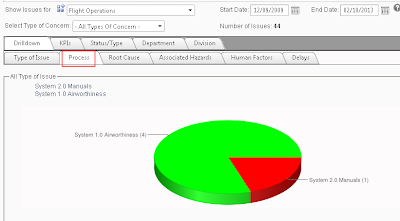
For five years, only a few operators (out of several hundred) took the time to configure and use the optional Business Processes classification system. The purpose was for an operator to list operational and administrative procedures and processes. Once the list was compiled, these procedures and processes could be assigned to reported issues. As time passed, managers could easily see which procedures and processes needed review and possible change. Classification of issues using Business Processes was the same as everywhere else in the Web based aviation safety management software, first from dropdown lists, finally to drag and drop, which was introduced in early 2010.
Airline airport Aviation safety management software
Business Processes Appear in Many Parts of SMS Pro

Business Processes had its own section in:


Integration of Business Processes and Policies & Procedures

Since Business Processes was virtually unused by hundreds of companies using SMS Pro, NWDS decided in February 2013 to integrate Business Processes into the Policies and Procedures. What does this mean? How will this affect functionality?

The phrase "Business Processes" will neither appear on the Classify tab in Issue Manager nor in the reports. The phrase "Business Processes" is exchanged with Policies and Procedures or something similar. In these sections, you will see a list of policies and procedures from the Policies & Procedures module.

For example, when you classify issues on the Classify tab, you will see a treeview list of your policies and procedures. Drag the applicable policy or procedure from left to right to classify the issue. When SMS Admins create a new classification under Policies and Procedures, a new policy or procedure will be created in the Policies & Procedures module. Likewise, when a manager creates a new policy or procedure in the Policies & Procedures manual, the item will appear in the list of items to classify issues or to view in the reports.


Integration of Business Processes with Policies & Procedures Is Optional

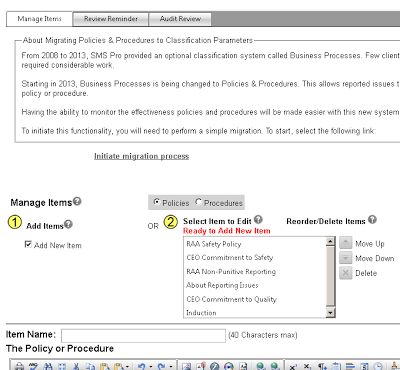
Airlines and airports using the Business Processes don't have to lose the work they have done in the past with their business processes. For those wishing to integrate their business processes with their policies and procedures, the process is simple:
  1. In Policies & Procedures module, go into "edit" mode;
  2. At the top of the page, you will see a section to initialize migration. This will only appear if your business processes are not integrated with your policies and procedures.
  3. Select the "Initialize Migration" link and in one or two seconds, the process is complete.
  4. Refresh your screen and the section will have disappeared.
Aviation safety management software
Policies & Procedures Integration Is Optional, But Recommended

What Happens to the Old Data?

The old business process classifications remain in the database. They are simply "deactivated" and will no longer appear. This ensures that historical records maintain their referential integrity.


Aviation Safety Management Software


About NWDS - founded in 2003 by six software engineers, NorthWest Data Solutions (NWDS) provides custom computer programming and systems design services. NWDS creates many types of software, including e-commerce, financial, defense, engineering, logistics, aviation and more. In 2007, NWDS developed SMS Pro™ a web based SMS application that supports an organization's overall SMS through safety reporting, safety documentation, safety risk management and safety assurance. SMS Pro™ is currently used by aviation organizations in the U.S., Canada, Asia, Latin America, Africa and the Middle East to help manage their SMS programs. NWDS continues to support SMS Pro™ and add new functionality. NWDS offers custom contract programming services in the U.S. and Canada and is managed by Chris Howell, one of the founders. Their headquarters is in Anchorage, Alaska. For information on NWDS visit their website at www.nwds-ak.com and www.asms-pro.com to learn more about SMS Pro™.

Friday, February 8, 2013

Enterprise Risk Management in Aviation Safety Management Systems

Risk Management in Aviation Safety Management Systems (SMS)

Top Management is Accountable!
Top management is accountable for the implementation of airline and airport aviation safety management systems (SMS). Responsibility can be delegated to safety managers, but top management is ultimately accountable for the successful implementation. Top management delegates these responsibilities, and as part of the delegation process, top management sends safety managers to aviation safety management courses to ensure their safety managers have an adequate understanding of what is required in an aviation safety management system.

In some cases, the safety manager brings back the knowledge gained from the aviation safety management courses and disseminates the information to other managers and employees. The point to fix on is that this does not happen all the time. And top management is still accountable regardless of how well the safety manager performs his task.

Who Audits the Safety Manager at Your Airline/Airport?

How does top management know whether the safety manager is doing a good job? Who is auditing the safety manager internally? Should your airline or airport jeopardize your certificate and wait for civil aviation authorities to conduct their audit and present you with a list of deficiencies? How does top management manage the risk in their enterprises to ensure they don't get caught off guard?

How Do You Know Your Aviation SMS Program is Working?

Internal aviation safety audits are important. One important point to bring out is that your internal safety audits should not be performed by the safety manager. You want an impartial eye performing the audit and you need to ensure that your required elements are documented in a way that aviation SMS auditors can confidently agree that you have fulfilled the requirements.

Aviation SMS Software helps!
To perform your aviation SMS audit, you will need an aviation SMS audit checklist. If you don't have an aviation SMS audit checklist, you have a few alternatives:
  1. Wing it (not the best choice);
  2. Ask the auditor for a copy (sometimes they will oblige);
  3. Use a gap analysis checklist (like in SMS Pro, which has several models, such as ICAO, IS-BAO, FAA, Transport Canada);
  4. Use an implementation plan checklist (like the ones provided in SMS Pro, such as ICAO and Transport Canada).
Transport Canada put out an advisory circular that has some good checklist. Here is the link to the document.
http://www.tc.gc.ca/media/documents/ca-opssvs/107-001-e.pdf 

For airlines and airports just starting their aviation SMS implementation, top management should be asking these questions, which have been extracted from this AC.

Component 1 – Safety Management Plan 

Element 1.1 Safety Policy

  1. Is a safety management system with defined components established, maintained and adhered to?
  2. Is there a safety policy in place?
  3. Is the safety policy approved by the accountable executive?
  4. Has the organization based its safety management system on the safety policy?
  5. Is the safety policy promoted by the accountable executive?
  6. Is the safety policy reviewed periodically?
  7. Is the safety policy communicated to all employees with the intent that they are made aware of their individual safety obligations?


Element 1.2, Non-Punitive Safety Reporting Policy

  1. Is there a policy in place that provides immunity from disciplinary action for employees that report safety deficiencies, hazards or occurrences?


Element 1.3, Roles & Responsibilities

Checklists are tools to guide you!
  1. Has an accountable executive been appointed with responsibility for ensuring that the safety management system is properly implemented and performing to requirements in all areas of the organization?
  2. Does the accountable executive have control of the financial and human resources required for the proper execution of his/her SMS responsibilities?
  3. Does the person managing the operation of the SMS fulfill the required job functions and responsibilities?
  4. Are the safety authorities, responsibilities and accountability of personnel at all levels of the organization defined and documented?
  5. Do all personnel understand their authorities, responsibilities and accountability in regards to all safety management processes, decisions and actions?


Element 1.4, Communication

  1. Are there communication processes in place within the organization that permit the safety management system to function effectively?
  2. Are communication processes (written, meetings, electronic, etc.) commensurate with the size and scope of the organization?
  3. Is information established and maintained in a suitable medium that provides direction in related documents?
  4. Is there a process for the dissemination of safety information throughout the organization and a means of monitoring the effectiveness of this process?


Element 1.5, Safety Planning, Objective & Goals

  1. Have safety objectives been established?
  2. Is there a formal process to develop a coherent set of safety goals necessary to achieve overall safety objectives?
  3. Are safety objective and goals publicized and distributed?


Element 1.6, Performance Measurement

  1. Is there a formal process to develop and maintain a set of performance parameters to be measured?


Element 1.7, Management Review

  1. Are regular and periodic, planned reviews of company safety performance and achievement including an examination of the company‘s Safety Management System conducted to ensure its continuing suitability, adequacy and effectiveness?
  2. Is there a process to evaluate the effectiveness of corrective actions?


Not Knowing Aviation SMS Requirements is not a Valid Excuse

When the aviation SMS auditor visits your airline or airport, you will not be able to plead ignorance. Top management is expected to know what is required of an effective safety management system. It is not like aviation safety management systems fell from the sky last week.

More Resources: http://www.ibac.org/is_bao/accredited-auditors-2


About NWDS - founded in 2003 by six software engineers, NorthWest Data Solutions (NWDS) provides custom computer programming and systems design services. NWDS creates many types of software, including e-commerce, financial, defense, engineering, logistics, aviation and more. In 2007, NWDS developed SMS Pro™ a web based SMS application that supports an organization's overall SMS through safety reporting, safety documentation, safety risk management and safety assurance. SMS Pro™ is currently used by aviation organizations in the U.S., Canada, Asia, Latin America, Africa and the Middle East to help manage their SMS programs. NWDS continues to support SMS Pro™ and add new functionality. NWDS offers custom contract programming services in the U.S. and Canada and is managed by Chris Howell, one of the founders. Their headquarters is in Anchorage, Alaska. For information on NWDS visit their website at www.nwds-ak.com and www.asms-pro.com to learn more about SMS Pro™.